
AI Voice Agent for Real Estate: Qualify Leads Before They Cool
An AI voice agent for real estate calls portal enquiries in seconds, qualifies on budget and timeline, and books showings straight to your calendar.
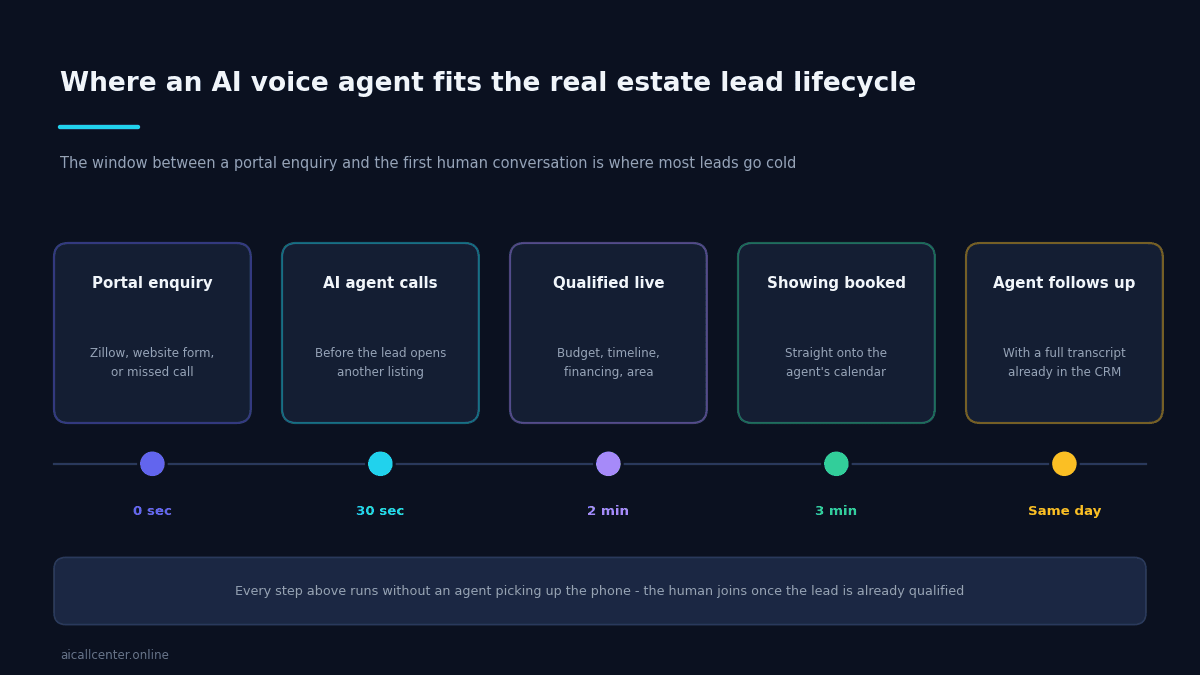
Real estate is a speed business disguised as a relationship business. The relationship matters enormously — but you only get to build it if you are the first agent who actually picks up. A buyer enquiring about a listing on a Sunday afternoon is, at that exact moment, also enquiring about four other listings.
An AI voice agent for real estate exists to win that window. It calls the enquiry back within seconds, has a genuine conversation, works out whether the person is a serious buyer or a Sunday browser, books the showing if they are, and hands your agent a qualified appointment with the full context attached.
This article covers where the agent fits in the lead lifecycle, what it should qualify on, the specific scenarios where it works well, and the situations where a human absolutely has to take over.
The Problem Is the Gap, Not the Follow-Up
Most brokerages have decent follow-up. What they do not have is instant follow-up. The enquiry arrives from a portal, drops into a CRM, sends a notification to an agent who is currently at a showing, and gets returned two hours later. By then the lead has spoken to someone else or moved on entirely.
That gap is structural. An agent showing a property cannot answer the phone, and an agent answering the phone cannot show a property. Adding more staff moves the bottleneck without removing it, because enquiry volume is spiky in exactly the hours when everyone is busy.
An AI voice agent does not replace the agent in that picture. It occupies the empty first three minutes, which is precisely the part no human was covering anyway.
What the Agent Should Qualify On
A real estate call that ends with “they seemed interested” has wasted everyone’s time. The agent needs to come back with specific, comparable answers, and that means deciding the criteria in advance.
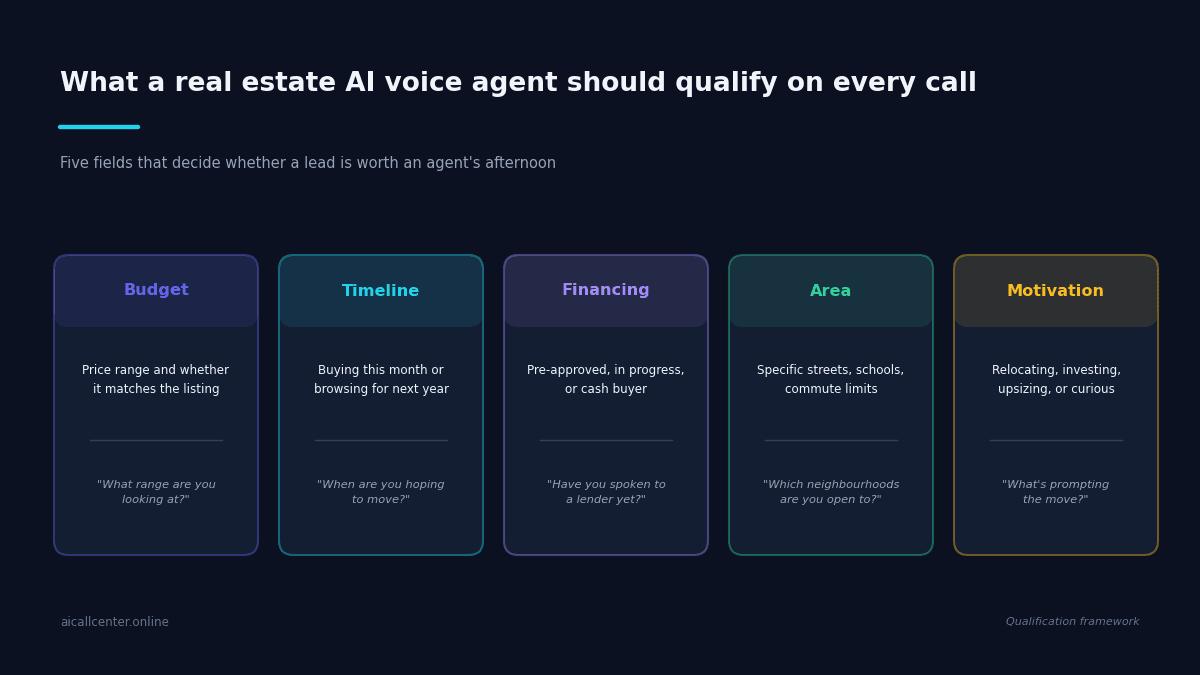
Budget tells you whether the enquiry matches the listing they called about, and whether there is something else on your books that fits better. Timeline separates the buyer moving in six weeks from the one idly planning next year. Financing is the single strongest predictor of whether a showing turns into an offer — pre-approved, in progress, or cash changes everything about how the lead should be handled.
Area catches the mismatch that wastes the most time, where someone enquires on a property in the wrong school district or an impossible commute. And motivation gives your agent the human context: relocating for work, investing, upsizing after a birth, or simply curious about what the neighbours got.
Asked consistently, these five turn into a lead scoring system that actually works, because every record has the same fields filled in the same way.
Where It Works Well
Portal enquiry response. The highest-value use by a wide margin. Zillow, Rightmove, your own site — the agent calls back in under a minute while the listing is still open in the lead’s browser.
Showing coordination. Booking, confirming, and rescheduling viewings eats an extraordinary amount of admin time. An agent that holds a live calendar can book directly, which is where AI for appointment scheduling earns its keep in a brokerage.
Database reactivation. Every brokerage has thousands of old leads nobody will ever call. Working that list at scale is only economically sensible when the cost per attempt is low, which is exactly the case that AI for lead generation is built for.
Open house follow-up. Twenty sign-ins on a Saturday, all of them warm, none of them called until Wednesday. The agent can work the entire list on Saturday evening.
Landlord and vendor enquiries. Valuation requests are usually high intent and low complexity — an ideal fit for a first call that gathers the property details and books the appraisal.
The Lettings and Property Management Case
Sales gets the attention, but lettings is arguably the better fit. The call volume is higher, the questions are more repetitive, and the value of any individual call is lower — which is exactly the profile that justifies automation.
Tenant enquiries follow a narrow script: is it still available, does it allow pets, what are the bills, when can I view. An agent that knows the answers can qualify against the affordability criteria and book viewings in batches, which is how most letting agents prefer to run them anyway.
Maintenance reporting is the other strong case. Tenants report issues at inconvenient hours, and most of those calls are about capturing details accurately rather than solving anything on the phone. An agent that logs the property, the fault, the urgency and the access arrangements produces a better ticket than a voicemail transcribed the next morning — and it can escalate genuine emergencies like a leak or a boiler failure straight to the on-call number.
Where a Human Has to Take Over
Being honest about the limits is what keeps this from backfiring. An AI voice agent should hand off immediately when the conversation turns to negotiation, offer strategy, or anything involving a number that could become contractual.
It should also hand off on emotional signals. Property transactions sit on top of divorces, deaths, job losses and relocations. A caller who mentions a difficult circumstance needs a person, not a qualification framework, and the agent should be instructed to transfer rather than continue.
Legal and disclosure questions are a third category. Anything touching representation, agency relationships or property condition disclosures belongs with a licensed agent — and in several jurisdictions, that is a regulatory requirement rather than a preference. Qualification questions themselves need care too: in the US, criteria that touch protected classes under the Fair Housing Act should never be part of an automated script. It is worth reading up on the general limitations of AI calling agents before you write the instructions.
The practical rule: the agent qualifies and schedules. It does not advise, negotiate, or represent.

Setting It Up Properly
Start with a single lead source. Point the agent at portal enquiries only and leave everything else on the existing process. One source means one set of transcripts to review and one variable to tune.
Load it with real inventory detail. An agent that can answer “does it have a garage” and “what are the service charges” holds a far better conversation than one that deflects every specific to a callback. Property facts are what make the call feel useful rather than like a screening interview.
Connect the calendar directly. A qualification call that ends in “someone will be in touch” throws away most of the value. The whole point is that the lead hangs up with a confirmed time, which is the same principle behind voice AI for appointment bookings in any scheduling-heavy business.
Set calling hours conservatively. Property enquiries arrive at all hours, but calling someone at 11pm reads as desperate. A window from 8am to 8pm local time, with anything outside it queued for the next morning, is a reasonable default.
Frequently Asked Questions
- How quickly should a portal enquiry be called?
- Within seconds, not minutes. Portal enquiries are almost never exclusive — the same buyer has usually enquired on several listings at once — so the agency that speaks to them first sets the agenda. This is the entire case for automating the first dial.
- What should an AI voice agent qualify on in real estate?
- Four things carry most of the value: budget, timeline, whether they need to sell or exit a tenancy first, and finance or mortgage status. Anything beyond that is better handled by the negotiator on the viewing call.
- Can it book viewings directly into our diary?
- Yes, and it should — offering live availability and confirming during the call is what separates a booked viewing from a callback task nobody gets to. It can also ring the day before to confirm or release the slot.
- Will buyers and vendors mind speaking to an AI?
- Buyers enquiring at 9pm generally prefer an immediate answer to a call back tomorrow. Vendors deciding who to instruct are a different matter — valuation and instruction conversations should go to a person, and the agent should be configured to transfer rather than pitch.
What to Expect
The first two weeks are calibration. Read every transcript, note the questions the agent could not answer, and feed those back into its knowledge. Most brokerages find the same three or four gaps and close them quickly.
Judge it on the right metric. The number that matters is not calls made or even leads contacted — it is qualified showings that your agents were happy to attend. If the appointments arriving on the calendar are ones your team would have wanted anyway, the system is working. If your agents are turning up to unqualified viewings, the criteria need tightening, not the technology.
Done properly, an AI voice agent for real estate does not change what your agents do. It changes how many of the right conversations they get to have.
If you are building the wider case internally, the complete guide to AI call center software covers how the technology is priced and rolled out beyond the property use case.
Ready to see how Ai Call Center can transform your business? Try our AI voice agent for real estate today or see AI voice agent pricing to find the perfect plan for your business.