
Multilingual AI Voice Agent for Customer Support Explained
How a multilingual AI voice agent detects and switches language mid-call, what changes operationally, and where the technology still falls short.
Supporting customers in a second language has always been an all-or-nothing decision. Either you hire native speakers, build a rota that covers their timezone, and accept the cost — or you route those callers to an English line, watch them struggle, and lose them quietly.
A multilingual AI voice agent changes the shape of that decision. Adding a language stops being a hiring project and becomes a configuration change. The agent detects what the caller is speaking, responds in it, and keeps the same policies and escalation rules it uses in every other language.
This article covers how the language switching actually works, what changes operationally when you stop hiring per language, where the technology still falls short, and how to roll it out without embarrassing yourself in a language nobody on your team speaks.
Why Language Coverage Breaks Support Teams
The economics are brutal. Each new language needs its own hires, its own training, its own coverage across the working day, and its own backup for holidays and departures. A single Spanish-speaking agent does not give you Spanish support — it gives you Spanish support between nine and five, minus sick days.
So most teams compromise. They cover one extra language properly, handle everything else with translation tools in chat, and route voice calls to whoever is available. Callers get the message quickly: this company does not really operate in my language.
That matters commercially. People make buying and trust decisions more readily in their first language, and the drop-off when they cannot use it shows up in conversion and retention long before it shows up in a complaint.
How the Language Switching Works
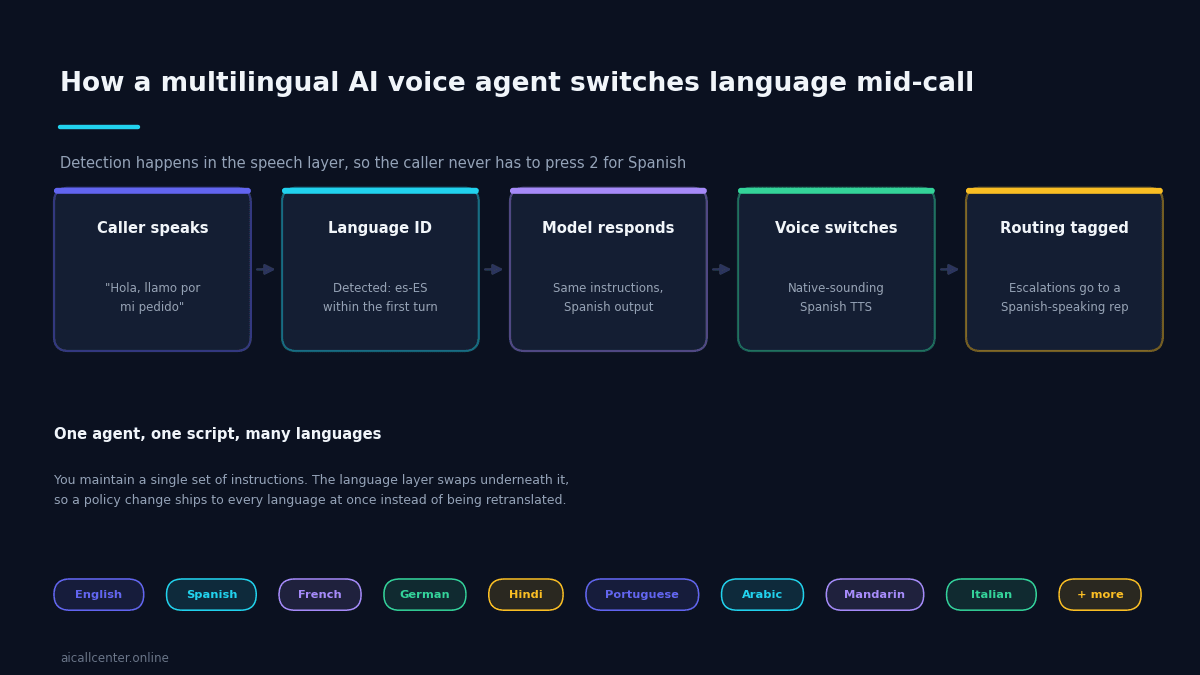
The mechanism is simpler than most people assume, and it happens in the speech layer rather than the reasoning layer.
The caller speaks. Speech recognition identifies the language within the first turn or two, usually without needing a full sentence. The model — which understands the instructions you wrote regardless of the language it is answering in — generates its reply in the caller’s language. Text-to-speech renders it in a native-sounding voice for that language. If the call later needs a human, the routing carries a language tag so it lands with someone who can continue.
The consequence worth understanding is that you maintain one agent, not one per language. Change your refund policy and the change applies everywhere at once. Under the old model, a policy update meant briefing every language team separately and hoping the translations stayed faithful.
What Actually Changes Operationally
The difference is less about cost and more about how quickly you can act.
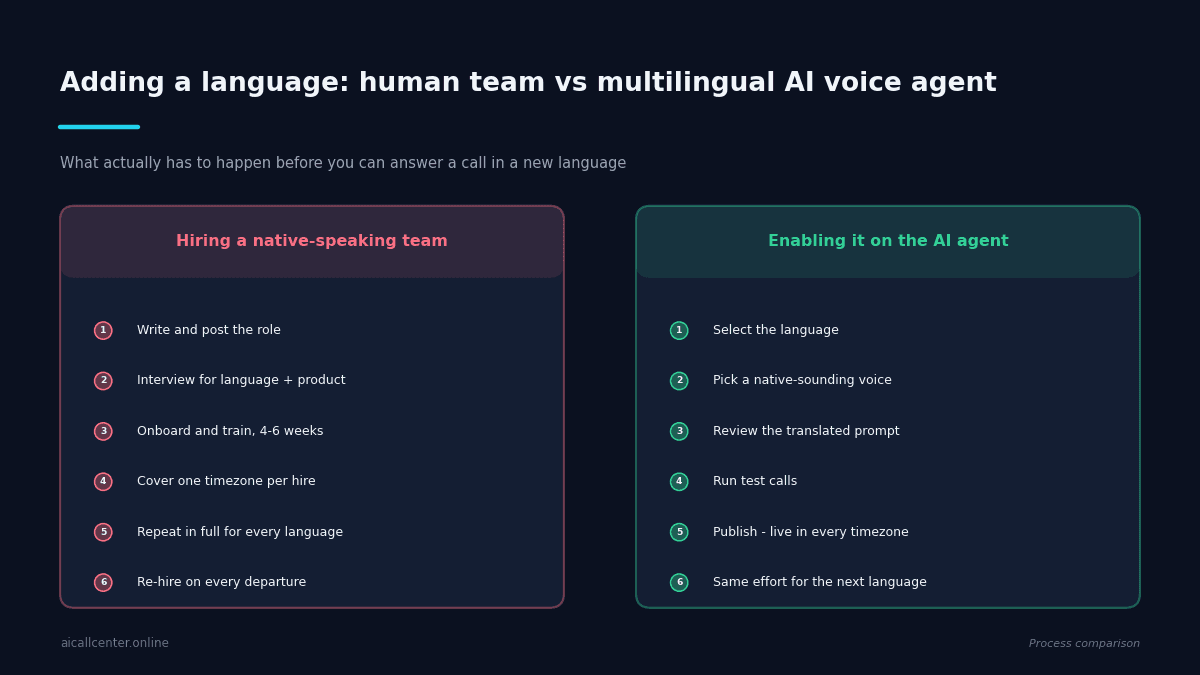
Adding a language becomes reversible. If you are unsure whether Portuguese support is worth it, you can switch it on, run it for a month, and look at the volume. Under a hiring model that same experiment is a twelve-month commitment to a person’s livelihood, so it never gets run and the question never gets answered.
Coverage also stops being timezone-shaped. An agent that speaks Japanese speaks Japanese at three in the morning, which matters enormously for a company with customers spread across continents and a support team in one city.
And smaller languages become viable. The languages that account for two percent of your volume never justify a hire, so they never get support. They cost effectively nothing to enable on an agent that is already running.
Where It Still Falls Short
Being clear-eyed here prevents the rollout that gets switched off in week three.
Quality is uneven across languages. English, Spanish, French, German and Mandarin are well served. Less common languages and regional dialects are noticeably weaker, both in recognition accuracy and in how natural the synthesised voice sounds. Test the specific languages you care about rather than trusting a count on a pricing page.
Accents and code-switching are hard. A caller who mixes English technical terms into Hindi, or speaks Spanish with a strong regional accent, will trip up recognition more often than a textbook speaker. This is the same class of problem covered in our piece on AI calling agent limitations, and it does not disappear just because the language is supported.

Cultural register is not translation. Directness that reads as efficient in German can read as rude in Japanese. Formality levels in Korean or the tú/usted distinction in Spanish carry real social weight. A literal translation of your English prompt will produce grammatically correct calls that land wrong, which is why a native speaker needs to review each language before it goes live.
Escalation needs planning. If the agent hands off to a human and no human speaks that language, you have moved the failure rather than fixed it. Decide in advance what happens: a callback promise, a written channel, or an interpreter service.
Choosing the Voice, Not Just the Language
The language is only half the decision. The voice you pick carries accent, age and register, and callers read all three immediately.
Regional accent is the choice people most often get wrong. Spanish rendered in a Castilian accent lands differently with a caller in Mexico City, and Portuguese in a European accent is noticeably foreign to a Brazilian customer. If a meaningful share of your volume comes from one region, pick the voice for that region rather than the default.
Speaking pace deserves attention too. Synthesised speech that sounds natural in English is often slightly too fast in languages with longer words or denser syllables, and callers ask for repetition more than they should. Most platforms let you adjust this, and a small reduction usually improves comprehension without making the agent sound slow.
Test the voice on your actual vocabulary before launching. Product names, street names and technical terms are where synthesis most often stumbles, and a mispronounced brand name every call is a steady, quiet irritation.
Rolling It Out Sensibly
Start with one additional language, chosen from data rather than intuition. Look at where your traffic comes from and which enquiries currently go unanswered. The answer is often not the language your team assumed.
Have a native speaker review the prompt before launch, and again after the first fifty calls. This is the highest-value hour anyone will spend on the project. You are checking for register and phrasing, not accuracy — the model rarely gets the facts wrong, but it frequently gets the tone wrong.
Scope the first language narrowly. Order status, appointment booking, opening hours, basic troubleshooting. Complex or emotionally loaded conversations should route to a person while you build confidence. The general AI use cases in contact centres that work well in English are the same ones that work well elsewhere.
Then measure per language separately. An aggregate resolution rate hides the language that is quietly failing. Track containment, escalation and call duration for each one, and be willing to switch a language off if the numbers say it is not ready.
Frequently Asked Questions
- How does the agent know which language to speak?
- It detects the language from the caller’s first utterance and switches, rather than asking them to choose from a menu. You set the languages it is allowed to use and a default for when detection is ambiguous.
- Can it switch language mid-call?
- Yes, which matters more than initial detection. Callers code-switch constantly, especially on technical terms and place names, and an agent locked to the language it opened with will start mishearing halfway through.
- Is a multilingual AI agent as good as a native-speaking human?
- No, and it is worth being clear about that. It handles routine, structured conversations well in its supported languages. Nuance, dialect, idiom and emotionally charged calls are where it degrades, and those should transfer to a person.
- What does it cost to add another language?
- Operationally almost nothing compared with hiring for it — you configure and test rather than recruit. The real cost is quality assurance: somebody who speaks the language has to review transcripts, otherwise you have no idea how the agent is performing in it.
The Realistic Position
A multilingual AI voice agent will not match a fluent native speaker who knows your product deeply. For a subset of your calls, it does not need to. Answering an order status question in a customer’s own language at midnight is better than answering it in English at ten the next morning, and considerably better than not answering it at all.
Treat it as the first line rather than the whole service. Handle the routine volume in every language you can, escalate anything complex or sensitive to a person, and let the data tell you which languages deserve a human team next.
For the broader picture — the layers underneath language handling, and what the rest of the category costs — see the complete guide to AI call center software.
Ready to see how Ai Call Center can transform your business? Try a multilingual AI voice agent today or see AI voice agent pricing to find the perfect plan for your business.